Anticipatory Grief: When You Feel the Loss of What Isn’t Gone (Yet)
There’s a kind of grief that doesn’t come after something ends.
It comes when you realize something will end—or begin to accept that something may never be the same or become what you hoped.
It doesn’t always have a clear moment. Just a subtle but persistent feeling that something is changing…
or already has.
A relationship that feels different.
A version of your life that isn’t unfolding the way you imagined.
Onlooking aging parents.
A growing awareness that time—with people you love or in life more generally—is limited.
What many people are feeling in these moments is anticipatory grief.
What Anticipatory Grief Actually Is
Anticipatory grief is the emotional process of beginning to feel a loss before it fully happens.
It’s your mind and body starting to adjust to a reality that isn’t fully here yet—but feels increasingly true.
And because nothing has “officially” ended, it can be difficult to recognize.
How It Often Shows Up
Anticipatory grief doesn’t always feel like obvious sadness.
More often, it shows up in subtle, confusing ways:
A low-level heaviness you can’t quite explain
Feeling emotional after time with someone—even when nothing went wrong
A sense of distance in a relationship that hasn’t actually ended
Restlessness or questioning your life without a clear reason
Feeling both grateful for what you have and quietly aware it’s changing
Moments of thinking ahead—then pulling yourself back because it feels too much
Sometimes it’s more concrete:
Noticing your parent repeat the same story twice.
Realizing you’re stepping into roles they once held.
Sensing a relationship is nearing its end—even without words.
And sometimes it’s more internal:
Looking at your life and realizing it doesn’t feel the way you thought it would.
Recognizing that the close, connected family you imagined may never fully exist in the way you hoped.
Coming to terms with the fact that certain relationships may stay exactly as they are—not because you haven’t tried, but because they can’t meet you there.
Or noticing that a version of yourself—a path, a career, a way of being—didn’t unfold the way you expected.
Nothing has technically ended. But something inside you knows… that change, loss, an end is coming.
Grieving What Never Happened
One of the hardest parts of anticipatory grief is that sometimes you’re grieving something that never fully existed.
The life you thought you’d have.
The relationship you believed would work.
The version of family you hoped for.
There’s no clear loss to point to. You can’t say, this is what I lost—because technically, you never had it. And that makes it harder to validate.
From the outside, life might look fine.
Or even good.
But internally, there’s a quiet realization: this isn’t going to be what I thought.
And that carries grief.
Why It Gets Misinterpreted
Because this “never life” is an experience that’s hard to name, people often assume something is wrong.
So they start searching for what needs to be fixed:
the relationship
the job
the direction of their life
Sometimes change is needed. But often, what you’re feeling isn’t a signal to immediately act.
It’s a signal that you’re processing loss in real time, which is very different from something being broken.
How to Work With Anticipatory Grief (Instead of Against It)
The instinct is to move out of this feeling quickly.
To make a decision.
To change something.
To resolve it.
But anticipatory grief doesn’t move that way. It tends to lessen when it’s acknowledged—not avoided.
A few ways to work with it:
1. Name it directly
Instead of “something feels off,” try:
I think I might be grieving something that hasn’t fully happened yet.
That alone can create relief.
2. Get specific
Ask yourself:
What exactly feels like it’s changing or not becoming what I hoped?
This helps bring the feeling out of the abstract.
3. Don’t rush the process
You don’t have to process all of it at once.
Sometimes it’s enough to sit with one piece of it—for a few minutes, for today.
4. Notice the urge to fix
When you feel the pull to make a big decision, pause.
Ask:
Is this something I need to act on right now—or something I need to feel first?
5. Ground in the present without denying the future
You can hold both:
This matters to me.
And it’s not what I thought it would be.
A Different Way to Hold It
You don’t have to turn this into a decision or a plan right away.
Sometimes the work is to pause and ask: What am I actually grieving right now?
There can be a strong pull to fix the feeling—to make it go away, to resolve it quickly. But grief isn’t something to fix. It’s something to recognize as part of being human in a life that is always changing.
And while it can feel isolating, it’s also something every person encounters in their own way. There’s something steadying in that—knowing you’re not alone in holding it.
Additional Resources
If this topic resonates, here are a few places to go deeper:
From my work:
Grieving a Never Life → find post here
STUCK → download free ebook here
UNSTUCK → a guide on how to move forward here
Books:
If this resonates with you:
I recently released UNSTUCK — an ebook exploring how to move forward. (The sequel to my free ebook, STUCK.)
Explore Unstuck — $39 →Here
New here? Join the IAMWELL Newsletter + receive STUCK, my free ebook.
Let’s stay connected. You can find me on Instagram at @IAMKIMEGEL

























A Therapist’s Thoughts on Love, Friendship & Career

I love hearing about the lessons and ways of thinking that people arrive at based on their experiences in life. I’m always drawn toward articles, books and interviews where people discuss and are asked about “advice to their younger self.” We all hold so much knowledge based on the experiences and life passages that we have already gone through. Today I’m going to touch upon some feedback that I have, at this point of my life, around the topics of love, friendship & career. These topics are super vast, so I’ve done my best to keep this short and concise, yet raw and truthful.
Here it goes:
What advice would you give to your younger self about LOVE?
If you're unavailable, you will attract unavailable. Period, the end. Man, I know this one.
Be the partner you want to attract. If you want someone athletic, make sure you get out there and get your sweat on. If you want a go getter, make sure you're going after what you want in your own life. If you want someone who loves to adventure, yup, you guessed it, make sure you're down to explore and are open minded to new things. Bottom line, make sure you possess and are actively partaking or working toward what you’re saying you want in a relationship. Like attracts like. Become what you want and it will show up.
Surround yourself with a partner that builds you up, respects you and one whom you feel really good about yourself around. How you feel about yourself when you’re in the presence of another is a huge piece of information. Pay attention.
It’s so cliche, but trust your gut, your inner knowing, the feeling that’s a constant under tone about the relationship that your choosing to be in. Whatever your gut is saying is the truth.
Make sure that, for the most part, your partner’s actions and words match up. If they don’t you have reason to not fully trust them. I know that I trust the relationships in my life that are consistent and reliable. Mean what you say: Say what you mean. Especially within the little things. The little things are a reflection of the bigger things. That’s how trust is built and protected. Be and seek people whose word matches their actions.
Letting go is hard and sometimes the answer. Not all relationships are meant to be forever, even when you want them to be. This is a tough one.
What advice would you give to your younger self about FRIENDSHIPS?
Good friends will tell you the truth in a respectful way. I’ve had some moments in my life that stand out to me where I’ve posed a really difficult question about my life situation to a friend and they’ve looked me dead in the eye and told me the truth, not what I wanted to hear. These can be and are often two very different things. I love the friendships in my life that I know will always say it to me straight. Cheers to honesty with respect and good intentions. Bottom line: Solid friendships are built around authenticity and honesty, even when it might be hard to hear.
Be the friend you want to attract. (Similar to the partner you want to attract.) Learn to possess and BE what you appreciate in another.
Good friends warm your heart and want the best for you. A true friend doesn’t try to “one up” you or compete with you. They just don’t.
If you can’t be yourself in a friendship, what’s the point? Seriously.
Solid friends are solid people. I’m really protective of who I bring into my world because friendships can influence and encourage us to grow or they can block our light. I have a no tolerance policy for low vibe, light blockers. Nor should you. I’m going to go out on a limb by saying that one of the best things I’ve created in my life is my circle of solid, honest, trustworthy and dependable friends. My friends have been and continue to be my largest support system.
What advice would you give to your younger self about CAREER?
Pick a career that matches who you really are vs. who you want to be. Make sure you pick a career that matches your authentic self rather than who you wish you were. Meaning, be careful of getting swept up in an image or coolness factor of a career path. Be true and honest with yourself.
I know your parents love you, but do what you feel called to do, not what they want you to do. Pick a career that calls you. This might be different than the direction that others want you to go into for a multitude of reasons: family business, financial, comfort level, etc. I know that my parents don't really identify with my choice to become a small business owner. They both took a more structured career path. Regardless, I'm glad that I followed what felt true for me. In the long term, the chance of your success is higher if you follow your truth. Your the one who has to live with the reality of your own life.
It might take longer than you want to discover and thrive in your chosen field. Hang in there, it will be worth it in the end if you select a career that’s a true fit for who you are. I remember being in my late 20’s/early 30’s questioning what path I took. Starting my own business was unpredictable. There were days where I doubted where I was going and what I was doing, while other friends of mine were making "good money" and in solid careers. Now, approaching 40, (which I have so much more to say about; coming soon) I’m just starting to see the “fruits of my labor.” I’ve always believed that good, solid things, whether it be relationships, careers or self growth take time. In this fast world, I find myself grounding in the virtue of patience. There are just some things you can’t and should not speed up. I feel this to be true for the area of career.
I would love to open up more of a dialogue around these topics. We’re all teachers based on where we’re at in life and what our journey has taught us thus far. I’m planning on using some of my own personal relationships to further explore these questions and topics. Stay tuned and feel free to share what you've learned.
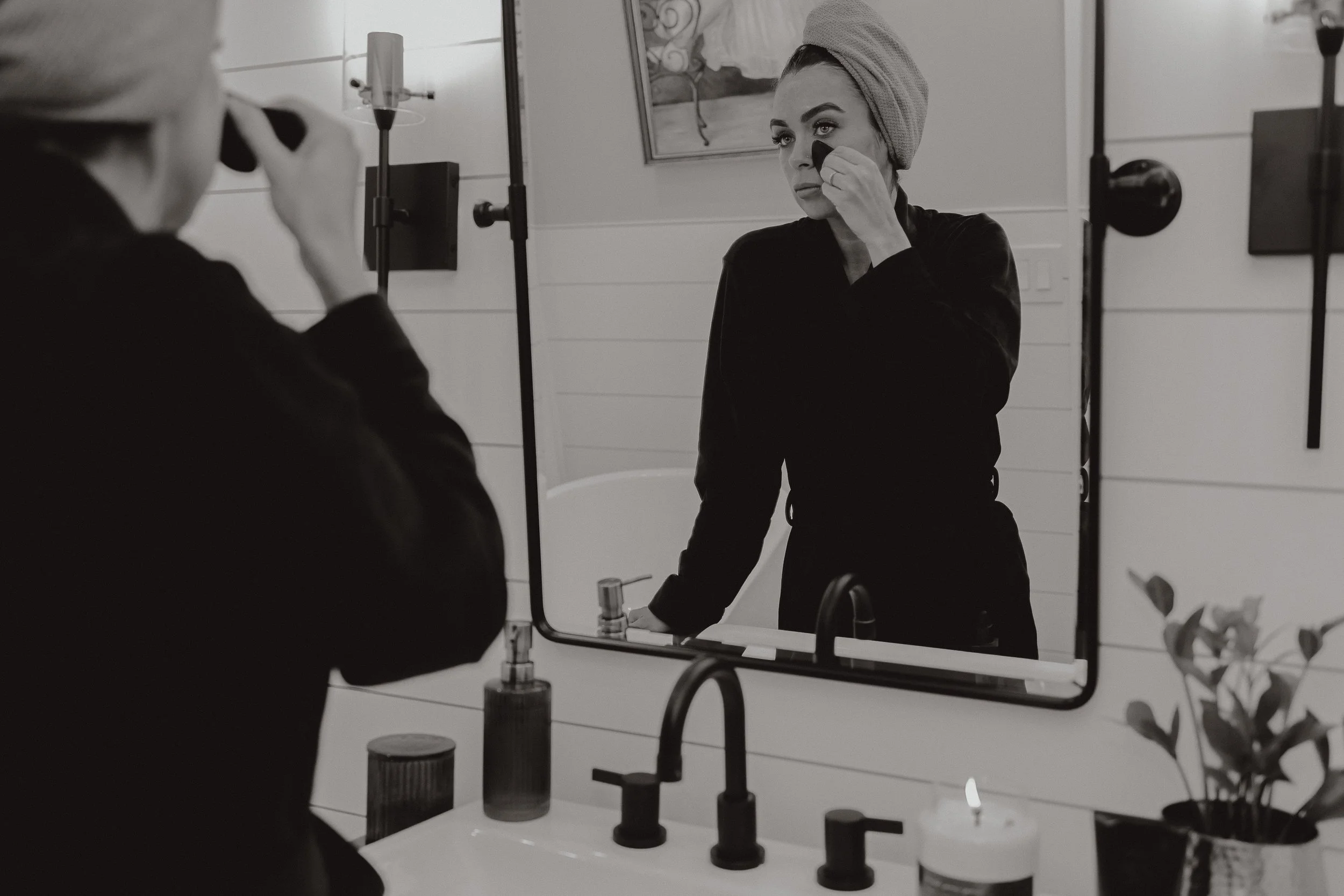
* The above image was taken by my good friend and photographer, Renata Amazonas.